Screenplay Adaptation
A psychological survival thriller about inherited violence, moral collision, and the triangle that forms when a foreign captive and a cartel lieutenant are bound by a child inside a closed camp.
When a retired foreign professional is abducted on a highway outside Culiacán and forced into a remote Sinaloa cartel camp, survival is only the first problem. The deeper reckoning is this: what becomes of the children born into a war they never chose—and what does it cost to interrupt that inheritance?
Adapted from the completed 125,000-word novel Cartel Babies, the screenplay distills a contained, character-driven thriller set almost entirely inside a cartel-controlled mountain camp—where brutality, tenderness, and routine coexist, and where one child’s presence destabilizes an entire system.
EᴠØ-Myth™ Thread
• Where Survival Meets Consequence — violence is inherited, not chosen
• Epoch — Modern México’s hidden war: unseen by tourists, lived by millions
• Axis — A foreign captive and a cartel lieutenant are bound by a child who should not exist inside this world
• Creation’s Lesson — Cartels are not built by monsters, but by boys who were never shown another exit
Story Engine
Inside a remote mountain camp supplying northwest México’s synthetic-drug economy:
• Abducted students mix chemical precursors
• Teenage recruits are hardened into soldiers
• Corrupt troops ferry product downslope for cash
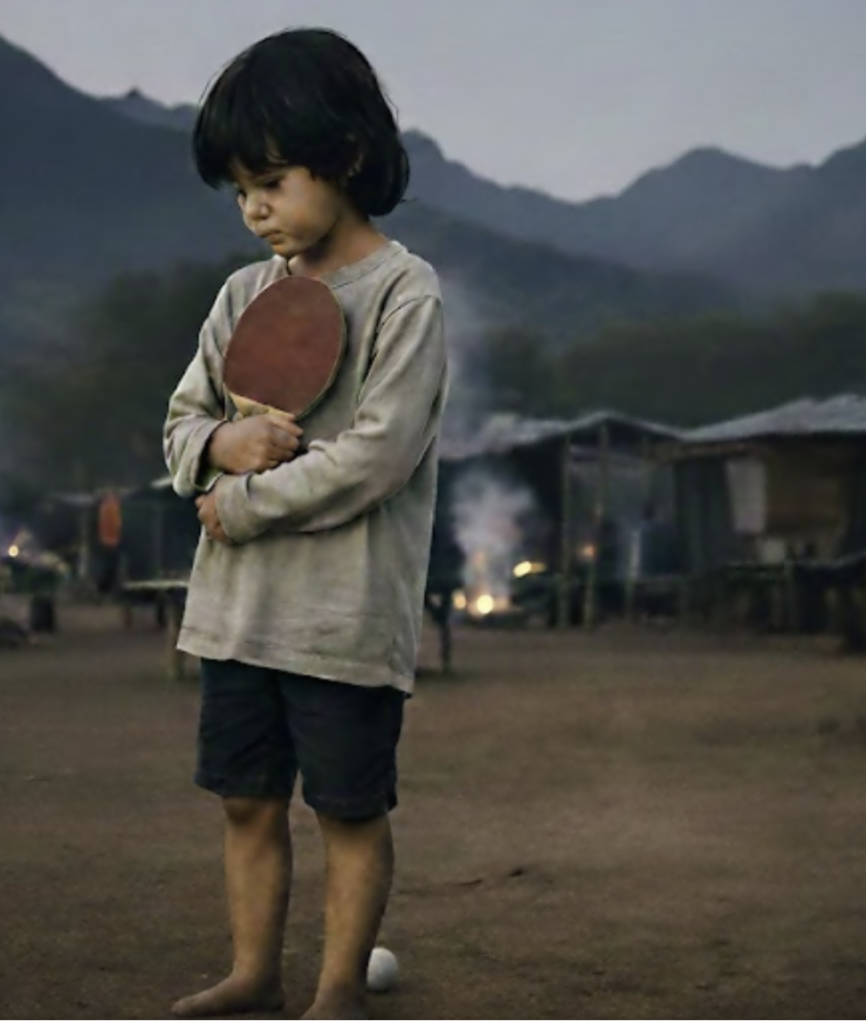
• A single child lives behind the fence—full time
The captive is older, disciplined, and trained in risk—an anomaly in a system built to break men quickly.
The lieutenant, Raúl, is violent, exhausted, and fiercely devoted to his ten-year-old son.
Their collision forms the emotional core of the film.
Not an escape story alone—but a story about whether escape is even allowed when bloodlines are involved.
Thematic Core
Some prisons are built with metal.
Others are built with lineage.
The screenplay explores:
• Inherited violence versus chosen morality
• Fatherhood inside criminal systems
• The psychology of survival under constant threat
• How children become the most dangerous variable in any closed system
• The cost of breaking a cycle that sustains an entire economy
Cinematic Positioning
Tone: Grounded, restrained, psychologically immersive
Scale: Intimate, contained, high-tension
Approach: Human-centered realism without glorification
Comparable in tone and intent to:
• Sicario (Taylor Sheridan) — moral pressure and atmospheric dread
• The Power of the Dog (Don Winslow adaptations) — systemic violence and consequence
• Prisoners (Denis Villeneuve) — ethical erosion under pressure
• Born into Brothels — children trapped inside inherited exploitation
Why This Works on Screen
• A contained setting with escalating stakes
• A child-centered moral fulcrum that destabilizes power
• A foreign POV that invites the audience inside without voyeurism
• A father–son axis rarely explored in cartel narratives
• Violence treated as consequence, not spectacle
• Budget-conscious: a contained primary location and small core cast drive high tension without blockbuster spend
This is not a cartel power fantasy.
It is a story about what cartel power costs the next generation.
Development Status
• Screenplay: Completed feature-length screenplay adaptation.
• Source Material: Completed, polished novel.
• Supporting Worldbuilding: Cartel Babies: Encyclopedia of Knowledge
(300+ pages of non-narrative reference used for accuracy and restraint)
The screenplay adaptation is designed to stand alone—while benefiting from a fully realized narrative ecosystem.
Author’s Note
In July 2021, I moved to Culiacán without expat buffers or curated safety. I wanted to understand life as it is lived—not as it’s imagined from afar.
That experience reshaped how I understand danger, silence, and community—and informs every decision in this adaptation.
This story does not ask whether cartels are evil.
It asks what happens to the children born where evil is normalized—and whether one bond is enough to threaten an entire lineage.