Reflections on human destruction, nature’s suffering, and the slow collapse of a fragile world.

Cartel Babies: Before the Camp, There’s Us
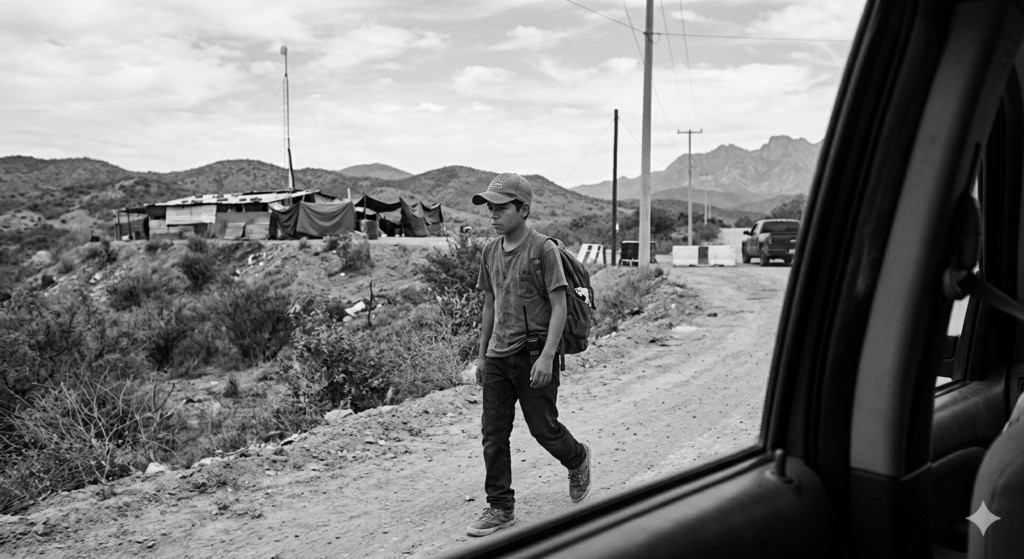
SUMMARY: The camp looks like an island—tin roofs, tarps, boys with radios—but it’s just the end of a road we all helped build. Every story I heard in Sinaloa came with the same shrug: “Él no tenía opción.” He had no choice. That’s how we talk when a system has eaten the choices already.
BACKGROUND: The labor engine that cooks synthetic drugs in the Sierra doesn’t start in the mountains. It starts in trade deals, in border policies, in ports, in the quiet demand for pills and powder far from here. It starts when a boy who learns to strip copper wire at twelve learns at fourteen that cooking pays better than school ever will.
WHAT IT LOOKS LIKE ON THE GROUND
Checkpoints where uniforms and unmarked trucks both wave you through—for a price.
Mothers who memorize plate numbers and convoy routes just to get kids to school.
Kids who can list calibers faster than bird species.
A camp where “promotion” means a radio, not a future.
LOSSES, NAMED
Childhoods traded for look-out shifts and night runs.
Fathers and uncles disappeared into “la sierra” with no HR file, no body, no grave.
Trust in any institution wearing a badge—or carrying a Bible.
The idea that leaving is possible once a boss knows your mother’s address.
HUMAN COSTS
Foreigners like me who can leave the highway one day and not come back the same—or at all.
Locals who never leave the valley but are still treated as accomplices by people who’ve never been here.
A region whose third face—the quiet majority—learns to speak in detours, lowered voices, and long looks at the floor.
WHAT WORKS (WHEN WE LET IT)
Work that pays as much as the camp without asking for a soul in installments.
Protection for witnesses and mothers who say “no” before the first radio, not after the first arrest.
Policy written with the voices of the families who stay, not just the ones who flee.
WHY IT MATTERS Cartel camps don’t appear from nowhere; they condense from everything we’d rather not see—trade, demand, impunity, and our appetite for stories that end before the cleanup. If a boy is born into a war he never chose, and every road out is watched, calling him a “predator” is a luxury of distance.
Dusky Gopher Frog: Fewer Than 200 Remain—Louisiana Restoration Offers Hope
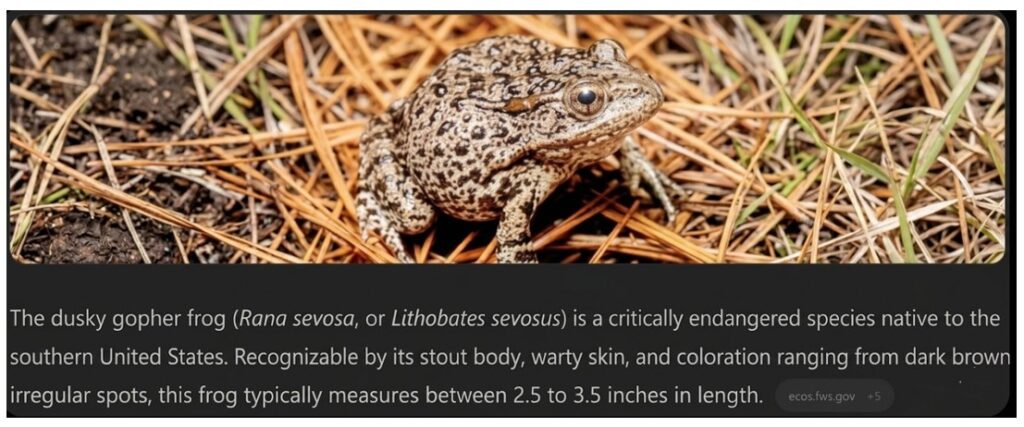
SUMMARY: The dusky gopher frog (Rana sevosa), a critically endangered species with fewer than 200 individuals left, relies on ephemeral ponds and longleaf pine forests for survival. After a years-long legal battle, a real estate developer ultimately prevailed when the U.S. Supreme Court ruled that land must be actual habitat to be designated as “critical habitat,” leading to the removal of protections on private land in Louisiana.
BACKGROUND: The dusky gopher frog’s situation is precarious. Historically found in Alabama, Louisiana, and Mississippi, its population has plummeted due to habitat loss, and remaining wild populations are now confined to a few locations in southern Mississippi.
In Weyerhaeuser Co. v. United States Fish and Wildlife Service (2018), the Supreme Court held that for land to be designated as “critical habitat” under the Endangered Species Act (ESA), it must first qualify as “habitat” for the species. The Court sent the case back to the Fifth Circuit to determine whether the Louisiana tract met that standard.
In 2019, a consent decree between the Fish and Wildlife Service (FWS) and the landowners removed the critical-habitat designation from the Louisiana site. This settlement allowed the landowners, including Weyerhaeuser Company, to retain control of the property without ESA critical-habitat restrictions.
WHAT IT LOOKS LIKE ON THE GROUND
Fewer than 200 individuals confined to a handful of ponds in southern Mississippi.
Longleaf pine forests—once spanning 90 million acres across the Southeast—reduced to less than 3% of their original range.
Ephemeral breeding ponds filled, drained, or paved over for development.
A Supreme Court ruling that said land must already be habitat before it can be protected as habitat—a legal circle that rewards destruction.
Private landowners free to develop the last viable reintroduction site in Louisiana.
LOSSES, NAMED
A species that has survived since the Pleistocene, now confined to a territory smaller than a subdivision.
Breeding ponds that fill for weeks, not months—timed to a cycle no developer’s calendar respects.
Longleaf pine ecosystems that once supported hundreds of interdependent species, burned on rotation by Indigenous peoples for millennia, now fragmented into islands.
Legal precedent that tells every endangered species the same thing: if your home has already been taken, it was never yours to protect.
ECOLOGICAL COSTS
Loss of a keystone burrower whose tunnels shelter dozens of invertebrate and reptile species.
Disruption of fire-dependent pine savanna cycles that maintain biodiversity across the Gulf Coast.
Genetic bottleneck: fewer than 200 individuals means inbreeding depression is not a risk—it’s a certainty.
Each pond lost eliminates not just frogs but the entire micro-ecosystem that depends on seasonal flooding.
HUMAN COSTS
Communities lose a living indicator species—the frog that tells you whether your water and soil are still functioning.
Restoration jobs and ecotourism potential bypassed in favor of one-time development payouts.
A legal precedent that weakens the ESA for every future species, in every future courtroom.
WHAT WORKS (WHEN WE LET IT)
The Nature Conservancy, FWS, and Louisiana Department of Wildlife and Fisheries preparing sites—such as the Talisheek Pine Wetlands Preserve—for reintroduction.
Prescribed burns restoring longleaf pine habitat to breeding-ready condition.
Captive breeding programs maintaining genetic diversity while wild sites are prepared.
Local water monitors and biologists tracking ephemeral pond cycles to time reintroduction windows.
WHY IT MATTERS: A frog that survived ice ages should not be erased by a zoning map. The dusky gopher frog doesn’t need much—seasonal water, open pine, and fire on a cycle. We know exactly what it requires. The question was never biology. It was whether a courtroom would let a forest be a forest long enough for 200 frogs to become 2,000. As of now, restoration offers a narrow but real hope—but only if we stop treating habitat as a legal technicality and start treating it as what it is: the ground a species stands on while it tries not to disappear.
CALL TO ACTION: Support prescribed burn programs and ephemeral pond restoration across the Gulf Coast longleaf belt. Pressure legislators to close the Weyerhaeuser loophole—habitat that could support a species should qualify for protection before it’s too late, not after. Fund the people doing the reintroduction work at Talisheek. And remember: if we can’t save a frog that only needs a pond and a pine forest, we have no business pretending we’ll save anything else.
British Columbia 1,800 Species at Risk

SUMMARY: Approximately 1,800 species in British Columbia are at risk—owls, caribou, seabirds, amphibians, salmon, and hundreds more—caught between industrial extraction, climate shift, and a province that inventories its losses faster than it prevents them.
BACKGROUND: British Columbia holds some of the richest biodiversity in North America: temperate rainforests, alpine meadows, salmon rivers, and coastal archipelagos. But that richness is being spent. Old-growth logging, mining, hydroelectric development, urban sprawl, and warming temperatures are compressing habitat faster than policy can protect it. The Species at Risk Act exists on paper; enforcement lags behind the cutting permits.
Three species illustrate the pattern:
Northern Spotted Owl (Strix occidentalis caurina): Once numbering over 1,000 in BC, the population collapsed as old-growth forests were logged out from under them. As of 2021, three individuals remained in the wild in Canada. Three. Captive breeding is now the only line between the species and extinction on Canadian soil.
Southern Mountain Caribou (Rangifer tarandus caribou): Woodland caribou have declined across Canada as industrial roads and cutblocks fragment their range, opening corridors for predators that follow the disturbance. Herds that once numbered in the hundreds now count in the dozens—or fewer.
Marbled Murrelet (Brachyramphus marmoratus): A seabird that nests in old-growth canopy—sometimes kilometers inland—and feeds at sea. It needs both systems intact. Logging takes one; ocean warming threatens the other. Listed as threatened under Canada’s Species at Risk Act, its population continues to decline.
WHAT IT LOOKS LIKE ON THE GROUND
Clearcuts visible from satellite where spotted owl territory used to be.
Caribou herds small enough to name individually—and still shrinking.
Murrelet nesting trees marked for protection one season, approved for cutting the next.
Salmon rivers running warm, shallow, and silted where cold, deep pools once held returning spawners.
Recovery plans published, funded partially, implemented slower than the losses they’re meant to reverse.
1,800 species on the list. The list grows faster than the funding.
LOSSES, NAMED
Old-growth forests that took 800 years to grow, logged in a shift.
Caribou migration corridors severed by roads, pipelines, and seismic lines that will take decades to close—if they ever do.
Salmon runs that once fed bears, eagles, forests, and First Nations communities, now reduced to fractions of historic returns.
Breeding pairs of spotted owls that could fit in a single tree—because that’s nearly all that’s left.
Indigenous knowledge systems built around species that are no longer there to teach from.
ECOLOGICAL COSTS
Loss of keystone predators and grazers destabilizes food webs from canopy to river mouth.
Old-growth removal eliminates carbon sinks, fungal networks, and moisture regulation that support thousands of dependent species.
Fragmented habitat creates genetic islands—populations too small and too isolated to recover without intervention.
Warming rivers push cold-water species like bull trout and sockeye into smaller and smaller thermal refuges.
HUMAN COSTS
First Nations communities lose cultural keystone species—salmon, caribou, cedar—that anchor ceremony, diet, trade, and identity.
Rural economies built on extraction face boom-and-collapse cycles as the resource base thins.
Tourism and guiding industries lose the wildlife that draws visitors in the first place.
The cost of recovery—captive breeding, habitat restoration, predator management—falls on future budgets that present governments refuse to fund.
WHAT WORKS (WHEN WE LET IT)
Old-growth deferrals that keep the last intact stands off the cutting schedule.
Predator-prey management informed by Indigenous land stewards who read the landscape in generations, not quarterly reports.
Captive breeding programs (spotted owl, caribou) that buy time—but only if habitat is restored before release.
Watershed-level salmon recovery that treats rivers as systems, not commodities.
Community-led monitoring that puts local eyes on the species year-round, not just during survey windows.
WHY IT MATTERS: British Columbia markets itself as “Super, Natural.” The tagline assumes the nature will still be there. At 1,800 species at risk—with three spotted owls left in the wild and caribou herds you can count on your fingers—that assumption is no longer earned. The province has the science, the mapping, the Indigenous knowledge, and the public will. What it lacks is the political willingness to say “no” to the next cut, the next road, the next dam, before another species crosses from “at risk” to “gone.” A list of 1,800 is not a catalogue. It’s a countdown.
CALL TO ACTION: Support old-growth deferrals and demand they become permanent protections. Fund First Nations–led guardian programs that monitor species and habitat year-round. Hold the provincial and federal governments to their own recovery timelines. And visit the Government of British Columbia’s Species and Ecosystems at Risk page—not to admire the list, but to understand what’s on it before the next name disappears.
Smokehouse Season, Interrupted: What Reservoirs Really Take
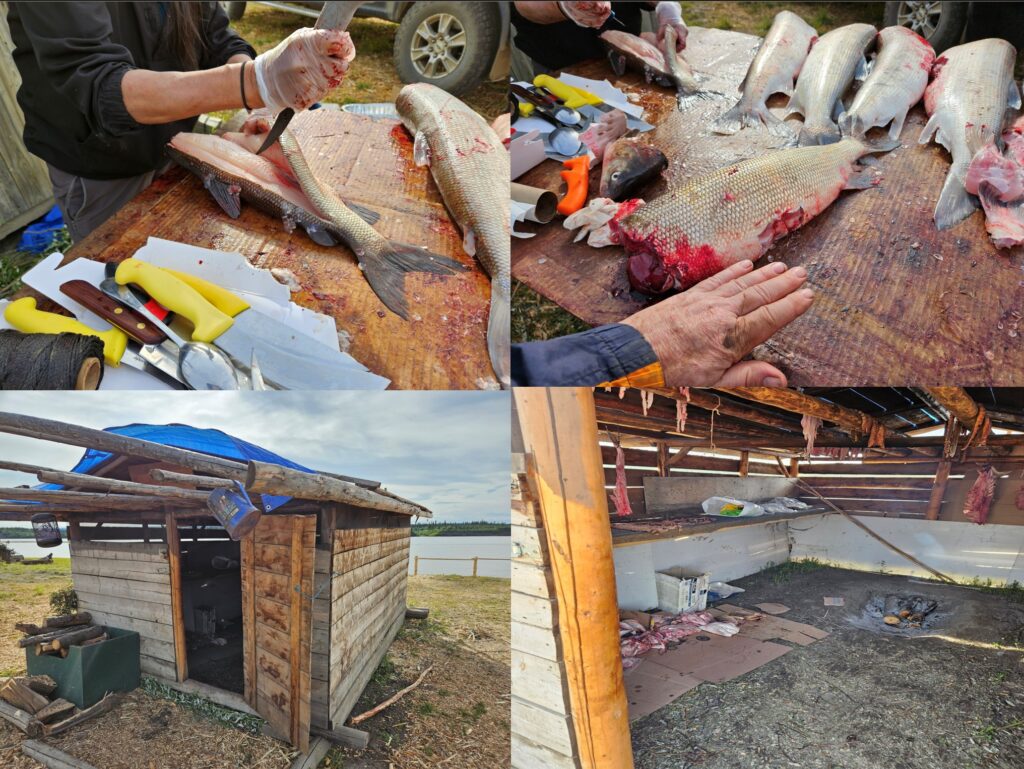
SUMMARY: Hydro corridors promise “reliable power.” On the ground, they pause smokehouse seasons, drown traplines, and turn fish camps into waiting rooms. This isn’t abstract. It’s water quality, fat on the fish, hands that have no work in June, and elders who must drive past their own river to buy store salmon wrapped in plastic. I keep hearing the same list: what the valley gave, what the reservoir took, and what never returns.
BACKGROUND: Reservoirs don’t just flood—they re-write calendars. Spring break-up arrives different. Shorelines slip. Ice forms later, thinner. Boat launches move. The stable places where nets once set clean become snag fields and weed mats. A “shoreline” that used to be a path is now a moving target.
WHAT IT LOOKS LIKE ON THE GROUND
A smokehouse that should be running in June, dark and empty because water levels haven’t stabilized.
Elders driving two hours past their own river to buy vacuum-sealed salmon from a grocery store.
Net sites marked by generations of use, now submerged under reservoir backwater or choked with debris.
Boat launches repositioned every season as the shoreline refuses to stay where it was.
Fish advisory signs where “keep and smoke” signs used to be.
Berry patches and garden plots hit by late frosts from reservoir-altered microclimates.
Kids learning current from a textbook instead of standing in it.
LOSSES, NAMED
Clean water that doesn’t bloom green in July.
Intact fish runs that hit their marks like clockwork.
Smokehouses lit on time, not “when the lake lets us.”
Traplines and trails that used to survive a thaw.
Burial grounds left where the stories put them.
Language tied to seasons, not shift schedules.
The right to decide what happens on the river that feeds you.
INDIGENOUS LIVELIHOODS: When smokehouses go quiet, it’s not just food security. It’s ceremony, teaching, and cash-work lost—guiding, selling fish, fixing nets, fueling boats. “Relocation benefits” don’t replace the map in your head: the bend where grayling stage, the eddy where whitefish sit, the shallow where kids learned to read current the way others read print.
ECOLOGICAL COSTS
Reservoir methylmercury climbs the food chain; “catch and release” becomes the rule where “keep and smoke” once was.
Microclimates shift around big lakes; late frosts bite gardens and berry patches; summer water warms into algal scum.
Beaver ponds drain or disconnect; muskrats thin; ducks skip traditional brood water.
Moose and caribou routes break—shorelines and crossings they used for generations now lead into open water or impassable brush.
Salmon (or trout/whitefish) runs shrink to rumor; spawning gravel silts over; tributaries cut new channels that ignore old wisdom.
HUMAN COSTS
Income drifts from fishing, guiding, and land skills toward corridor jobs—flagging, security, hauling. When the project ends, so does the paycheck.
“Move to town” becomes policy shorthand for opportunity. But off-reserve, most tax exemptions vanish; rent arrives every month; the river becomes a weekend drive, not a larder.
Grief shows up as “choice”: take the job or keep the camp. Families split the difference and lose both.
WHAT WORKS (WHEN WE LET IT)
Corridor reroutes that honor fish staging sites, burial grounds, and beaver complexes.
Drawdown rules that protect spawning windows and keep near-shore water from yo-yoing.
Local water monitors paid year-round—elders and youth logging turbidity, temperature, and blooms.
Procurement that favors boat shops, smokehouse suppliers, and on-river guides—keeping money in the current, not on the highway.
One simple test before any vote: “Drink from the water you plan to manage.” If that sentence makes a boardroom flinch, the plan isn’t ready.
WHY IT MATTERS: A corridor that delivers steady megawatts and unstable lives is not success. If the valley can’t smoke fish, if the graves move, if the river turns to something you visit instead of something that feeds you, the balance is gone. Stewardship isn’t “power on.” Stewardship is “smokehouse on, too.”
CALL TO ACTION: Keep smokehouse calendars intact when you draw project ones. Fund monitoring by the people who read the river best. Respect a “no” when the map crosses a memory. Power that erases place isn’t clean. It’s just quiet.
The River Eats the Road: Permafrost Slumps and the Cost of “Maintenance”
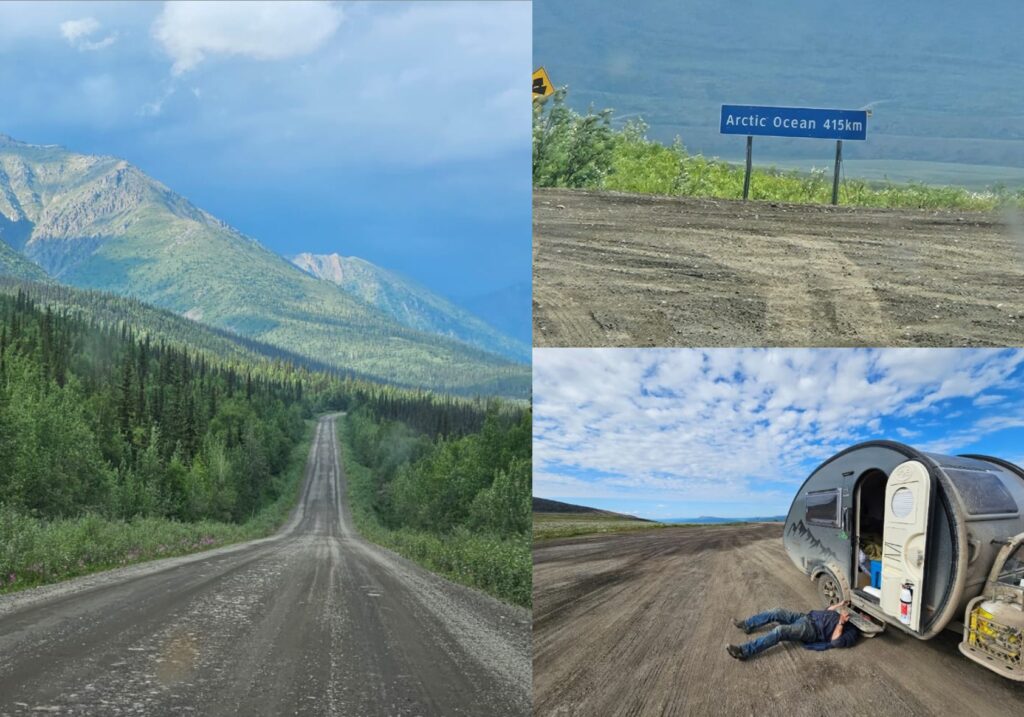
SUMMARY: Northbound highways and access roads look fixed until spring returns. Permafrost softens, banks slump, culverts choke, and the river pulls the edge back into itself. We call it “washout repair.” The river calls it gravity and heat. I keep thinking: we treat symptoms with gravel when the diagnosis is thaw.
BACKGROUND: What’s failing isn’t just asphalt; it’s ice-rich ground that once stayed frozen long enough to hold the grade. Survey lines, new ditches, and heat from dark road surfaces speed the melt. Water finds the easiest path, undercuts the fill, and turns a hairline crack into a throat that swallows trucks.
WHAT IT LOOKS LIKE ON THE GROUND
Shoulders shear off in long crescents; the guardrail hovers, then drops.
Ditches become creeks; culverts silt and “perch,” blocking fish passage.
Detours creep closer to the bank each season as the cut widens.
Bridges “heave” at the ends; frost boils rut the approaches.
The same orange cones return to the same kilometer markers—every year.
LOSSES, NAMED
Permafrost that held the grade for centuries, now softening faster than engineers can compensate.
Riverbanks that once defined the road’s edge, now reclaiming asphalt by the meter each spring.
Fish passage through culverts that used to flow clean—now perched, silted, or collapsed.
The assumption that a road, once built, stays where you put it.
Public trust in “temporary” repairs that have become permanent features of the drive.
INDIGENOUS IMPACT
Traplines and smokehouse runs stall when a single failing culvert blocks the only crossing.
School, clinic, and store trips stretch by hours or days when “temporary” closures become the season.
Safety nets shrink: a breakdown on a half-closed road is not the same as help in town.
Corridor crews get paid; camps lose money and time waiting for the road to reopen.
ECOLOGICAL COSTS
Perched culverts block upstream migration for fish that have used these tributaries for millennia.
Dark gravel absorbs heat, deepening the thaw bulb beneath the road and destabilizing adjacent wetlands.
Straight ditches accelerate meltwater delivery, scouring spawning gravel and eroding banks downstream.
Slumping shoulders dump fill and sediment into waterways, smothering invertebrate habitat.
Each “temporary” fix introduces new material—warm, dark, foreign—that accelerates the cycle it was meant to slow.
HUMAN COSTS
Communities at the end of a single road lose access to clinics, schools, and supply chains for days or weeks each breakup season.
Drivers and haulers risk their lives on surfaces that look solid but aren’t—frost boils, shoulder drops, bridge heaves.
Corridor construction jobs arrive with the project and leave with it; the road’s failures stay.
“Maintenance” budgets balloon without ever producing a permanent solution, diverting funds from infrastructure that communities actually control.
WHY “MAINTENANCE” MAKES IT WORSE
Repeated “top-ups” of warm, dark gravel absorb heat and deepen the thaw.
Undersized culverts speed water like a fire hose, scouring beds and banks.
Straight ditches deliver meltwater faster than the valley can handle.
Patchwork fixes keep the ledger off the project budget and on the land.
WHAT WORKS (WHEN WE LET IT)
Build light, not hot: pale aggregates, geotextiles, and venting layers that keep cold in the ground.
Oversize and fish-friendly crossings: multi-cell culverts or short spans that let water, fish, and ice move without tearing banks.
Set back from rivers: choose the hill line over the cutbank whenever the map allows.
Seasonal weight rules that follow the thaw, not the calendar.
Local monitors paid year-round to log slumps, culvert blockages, and early warning signs.
One hard promise: every “temporary” fix gets a date for a permanent solution—or it isn’t called fixed.
WHY IT MATTERS: “Maintenance” that returns like spring breakup isn’t maintenance; it’s a bill the river keeps sending back. If a road serves a fish camp, a smokehouse, a clinic, or a school, the crossing is not an optional line item. Put the money where the thaw already is—where the river eats the road—and build as if you plan to apologize to the valley for nothing.
CALL TO ACTION: Measure it, fund it, respect it. Demand permanent solutions with posted timelines for every “temporary” repair. Fund year-round local monitors who know where the slumps start before the engineers arrive. Build roads that work with the permafrost instead of against it—or stop pretending the road is fixed when the river knows better.
These laments live between the novels—where the real world shows what the stories are warning us about. Here the voice is stripped down—me, raw.
This is the one corner of the ecosystem where I try to write without distance—primal, raw. Me, raw.